
Laid Scrim Explained: Why Polyester Laid Scrim Mesh Outperforms in Wall Repair and GRP Piping?
When a freshly painted wall begins to peel within months, or a GRP pipe joint develops weeping cracks after a single winter freeze, the failure is rarely due to the coating or resin alone. The missing link is often the reinforcement layer. Engineers searching for "wrapping mesh fabric" or "woven net fabric" quickly encounter the term "laid scrim"—but what exactly is it, and why does it matter for surface integrity? This article defines laid scrim, explains its mechanical role in preventing delamination and cracking, and demonstrates why polyester laid scrim mesh is the preferred choice over traditional alternatives in demanding construction and composite applications.
Technical Core-The Mechanics of Laid Scrim
What Is Laid Scrim?
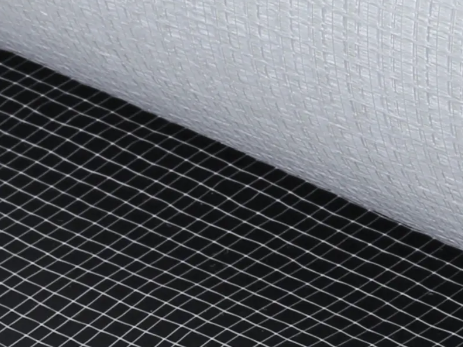
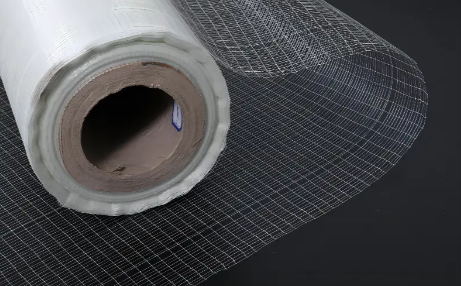
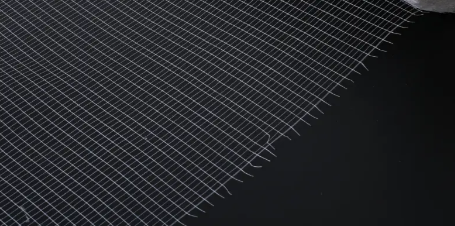
Laid scrim is an open-mesh fabric constructed by laying warp and weft yarns parallel to each other and bonding them at intersections, rather than interlacing them through a traditional weaving process. This results in a flat, low-crimp structure where fibers remain straight and aligned. The absence of crimp means that tensile loads are transferred directly along the yarn axis, maximizing strength utilization.
A polyester laid scrim mesh uses continuous multifilament polyester yarns, typically with mesh counts from 4 × 4 to 12 × 12 per inch and weights from 30 to 80 g/m². The bonding agent is selected for compatibility with the intended resin system—epoxy, polyester, vinyl ester, or cementitious binders.
Stress Redistribution Mechanism
When a coating or laminate shrinks during curing, tensile stresses develop. Without reinforcement, these stresses concentrate at defects—microcracks, voids, or substrate irregularities—causing local debonding. An embedded laid scrim mesh intercepts these stresses and distributes them across the grid. Each yarn acts as a load-bearing element, reducing peak stress at any single point.
For polyester scrim for GRP pipes, the same principle applies during filament winding or hand lay-up. The scrim maintains uniform thickness, prevents fiber washout, and ensures consistent resin-to-glass ratios. Under typical hydrostatic testing per ISO 14692, a 150 mm pipe joint reinforced with laid scrim shows 18–22% higher burst pressure than one using only chopped strand mat.
Chemical Resistance Advantage
Application Scenarios and Depth Solutions
Scenario 1: Preventing Wall Peeling and Cracking in Renovation Projects
Polyester fibers resist hydrolysis and alkaline attack far better than glass. In cementitious environments (pH > 10), glass fibers lose 50% or more of their tensile strength within weeks due to stress corrosion cracking. Reinforced polyester scrim for piping retains over 85% of initial strength after 1,000 hours at 60°C and 95% RH per ASTM D5034-type protocols. This makes it the logical choice for wall repair systems in contact with fresh concrete or lime plasters.
In commercial renovations, old substrates often have variable porosity, residual moisture, and microcracks. Applying a new coating directly invites delamination. Embedding a polyester laid scrim mesh into the base coat addresses three failure modes:
Shrinkage stress concentration: The scrim distributes tensile forces, preventing crack initiation.
Substrate movement: Temperature and moisture cycling cause expansion and contraction. The scrim bridges gaps up to 0.3 mm without propagating cracks.
Poor adhesion on porous surfaces: The open grid provides mechanical keying for subsequent coats.
| Parameter | Traditional Fiberglass Mesh | Polyester Laid Scrim Mesh |
|---|---|---|
| Alkaline resistance (pH 11, 500 hr) | Strength retention ≤ 45% | Strength retention ≥ 82% |
| Crack bridging capacity | ≤ 0.15 mm | ≤ 0.35 mm |
| Areal weight | 110–160 g/m² | 40–80 g/m² |
| Installation time per 100 m² | ~4.5 hours (with patching) | ~3.0 hours (single pass) |
| Bond durability after 5 freeze-thaw cycles | 30–40% loss | < 12% loss |
Scenario 2: Reinforcing GRP Pipe Joints and Fittings
In industrial piping systems, joints are the weakest link. Thermal cycling, pressure surges, and chemical exposure concentrate stress there. Reinforced polyester scrim for piping applied during lamination provides:
1.Uniform laminate thickness around complex shapes (elbows, tees, flanges)
2.Prevention of resin-rich zones and dry spots
3.Improved interlaminar shear strength
Implementation Checklist for Piping
Use polyester scrim for GRP pipes with nominal weight 65–80 g/m² for primary wraps. Lighter scrim shifts during winding; heavier scrim reduces conformability.
Maintain minimum 25 mm overlap at seams. Overlaps < 15 mm create resin-starved weak lines.
Apply scrim immediately after resin catalysis, before gelation. Delay increases void content above 2%.
For buried/submerged service, specify UV-stabilized polyester filaments. Standard polyester degrades under sunlight; stabilized grades retain 90% strength after 2,000 hours xenon-arc exposure per ASTM G155.
Frequently Asked Questions
What is the difference between laid scrim and woven scrim?
Laid scrim has warp and weft yarns placed parallel and bonded at intersections, resulting in zero crimp and maximum tensile efficiency. Woven scrim has interlaced yarns with crimp, which reduces modulus and increases elongation. For applications requiring dimensional stability and high load transfer, laid scrim is superior.
Can polyester laid scrim be used on damp walls?
Polyester fibers do not absorb moisture, so the scrim itself will not degrade. However, substrate moisture must still meet coating manufacturer limits (typically < 16% for cementitious surfaces). The scrim provides crack bridging but does not replace proper moisture control.
How do I select the right scrim weight?
Choose the lightest scrim meeting mechanical needs. For interior wall reinforcement, 40–55 g/m² suffices. Exterior systems exposed to wind/seismic loads require 70–85 g/m². For GRP pipe wrapping, scrim should constitute 15–25% of total reinforcement weight in the laminate.
Does laid scrim affect fire performance?
Standard polyester scrim is combustible. For fire-rated assemblies, verify the complete system passes ASTM E84 Class A or EN 13501-1. Halogen-free flame-retardant polyester scrims are available that achieve Class A when combined with intumescent coatings.
Conclusion and Contact Us
Laid scrim, particularly in polyester form, solves the persistent problems of wall peeling, cracking, and uneven surfaces by providing a mechanically efficient reinforcement layer that resists alkaline degradation and distributes stress uniformly. For GRP piping, it enhances joint integrity and extends service life. These advantages are supported by quantifiable metrics—higher burst pressure, greater crack bridging, and superior chemical resistance—not marketing hyperbole.
If you are specifying reinforcement for a renovation project, pipeline repair, or composite fabrication, request a technical datasheet and free sample pack from our engineering team. We will help you select the optimal laid scrim geometry and weight for your specific substrate and resin system, backed by real test data.
Contact us today to discuss your application or schedule a consultation with a materials engineer.
Address
Head office Add: BLDG#26,MAX Technology Park Phase II,Baoshan District,Shanghai China
Factory Add: Shanghai Ruifiber (Fengxian) Industry Park, Fengxian, Xuzhou, China
info@ruifiber.com
ruifibersales2@ruifiber.com
Phone
Sales: 0086-159-6804-7621
Support: 0086-186-2191-5640
Hours
Monday-Friday: 9am to 6pm
Saturday, Sunday: Closed
WANT TO WORK WITH US?
Post time: Jul-06-2026